
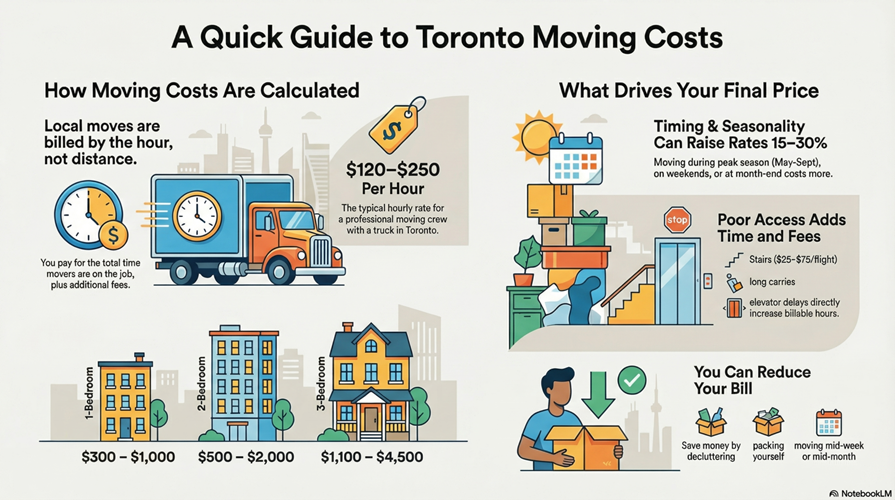
How Moving Costs Are Calculated in Toronto
Moving costs in Toronto depend primarily on whether your move is local or long-distance. Local moves (generally within the GTA or under ~160 km) are almost always billed by the hour, while long-distance moves are typically priced using flat-rate or volume-based pricing.
In practice, Toronto movers calculate pricing using a base rate and then adjust for logistics such as time, access, inventory, and special handling. The final price is rarely a single number — it’s the result of multiple real-world variables working together.
Takeaway: In Toronto, you’re not paying for distance — you’re paying for **time + logistics**.
Real Toronto Moving Rates in 2025
For local moves, professional moving companies in Ontario charge hourly rates based on crew size and service level.
Typical Hourly Ranges
Most professional Toronto movers charge $120–$250 per hour for a standard crew (2–3 movers with a truck). Rates significantly below $90–$150 per hour often indicate hidden fees, uninsured crews, or incomplete service coverage.
Estimated Total Costs by Home Size
- ✔ Studio / 1-Bedroom: $300 – $1,000 (≈ 3–4 hours)
- ✔ 2-Bedroom: $500 – $2,000 (≈ 5–7 hours)
- ✔ 3-Bedroom: $1,100 – $4,500 (≈ 7–9 hours)
- ✔ 4+ Bedroom Homes: $2,000 – $7,000+
Long-Distance Flat-Rate Examples
- ✔ Toronto → Ottawa: $1,200 – $2,000
- ✔ Toronto → Montreal: $1,500 – $2,500
These prices reflect average household volumes with standard access conditions.
How Toronto Movers Actually Charge
Most Toronto movers use a straightforward pricing formula:
(Hourly Rate × Time Spent) + Additional Charges = Final Price
What that typically includes:
- ✔ Minimum bookings: Most reputable movers require a 3–4 hour minimum
- ✔ Travel / truck fees: A one-time charge (typically $100–$300) covering dispatch time to and from your location
- ✔ Taxes: 13% HST applies in Ontario
- ✔ Credit card payments may include ~3% processing surcharge
What Drives Your Final Moving Cost
Several factors have a direct impact on the total price of a Toronto move:
-
Timing & seasonality
Peak season (May–September) can raise rates 15–30%. Weekends and month-end dates cost more; mid-week and mid-month moves are often 10–15% cheaper. -
Building access & logistics
Additional labour is required for:- Stairs: $25–$75 per flight
- Long carries from distant parking areas
- Elevator booking restrictions and wait times
-
Specialty or heavy items
Pianos, safes, pool tables, antiques, and oversized furniture commonly add $100–$500+ per item due to extra labour or equipment. -
Packing & supplies
Packing labour: $40–$80 per hour
Materials: a full packing kit for a 4-bedroom home can exceed $650
Insurance & Protection Options
Released Value Protection
The legal minimum in Ontario, covering items at $0.60 per pound (≈ $1.32/kg). This is usually included at no extra cost.
Full Value Protection
Provides repair or replacement at market value. Typically priced at ~1% of the total declared value of your belongings.
A Simple Way to Think About Moving Costs
Hiring movers is like renting a professional kitchen by the hour. The base fee covers the space and the chefs — but the final bill depends on:
How many “dishes” you prepare (your inventory)
Whether they supply the ingredients (packing materials)
Whether everything is on the ground floor or carried up a narrow fire escape (logistics and stairs)
Average Moving Costs in Toronto (Quick Overview)
This quick snapshot gives immediate orientation for local vs long-distance pricing before we go deeper into how quotes are built.
Average moving costs in Toronto depend mainly on home size and distance. Most local moves within the GTA are billed hourly, with typical rates ranging from $120 to $200 per hour for a standard moving crew. As a result, total costs for local moves usually fall between $300 and $1,000 for a one-bedroom apartment, $1,100 to $1,400 for a two-bedroom home, and $1,500 to $4,500 for a three-bedroom residence, while large four-bedroom houses can reach $7,000+ depending on access and logistics.
Long-distance moves from Toronto are generally priced using flat-rate or volume-based quotes, factoring in mileage and shipment size. Common regional routes—such as Toronto to Ottawa or Montreal—typically range from $1,200 to $2,500strong>, while cross-country moves can cost significantly more. Pricing also fluctuates throughout the year, with peak summer months often increasing rates by 15% to 30%strong> compared to off-season moves.
Average Moving Costs by Move Type
Local Moves in Toronto (GTA / Under 150 km)
Local moves within the Greater Toronto Area are typically completed in a single day and are almost always billed using an hourly-rate model. Pricing is based on crew size, time on site, and access conditions rather than distance alone.
Typical Hourly Rates (2025)
• $120–$250 per hour for professional Toronto movers
• A 2-mover crew with a truck usually ranges from $130–$160 per hour
• A 3-mover crew typically ranges from $190–$220 per hour
Most reputable moving companies also apply a 3–4 hour minimum booking, which helps ensure proper crew allocation and realistic scheduling.
Estimated Total Costs by Home Size
• 1-Bedroom apartment: $300 – $1,000
• 2-Bedroom home or condo: $500 – $1,900
• 3-Bedroom house: $1,100 – $4,500
• 4+ Bedroom homes: $2,000 – $7,000+
Why Toronto Pricing Differs From Other Cities
Toronto moves are shaped by dense urban conditions that directly affect labour time. Condo elevator booking windows, loading dock restrictions, traffic congestion, limited street parking, and older housing stock with narrow staircases all add complexity. While Ontario’s average moving cost is often reported lower than other provinces due to shorter intra-city distances, Toronto’s access and logistics challenges frequently push actual labour hours higher than in smaller cities.
Long-Distance & Intercity Moves
Long-distance moves generally apply to relocations over 160 km (100 miles) or moves requiring multiple travel days. Unlike local moves, these relocations are rarely billed hourly.
Flat-Rate vs Weight-Based Pricing
Flat-rate pricing provides a guaranteed total cost based on distance, inventory volume, and services selected. This model is common for intercity moves where scope can be clearly defined.
Weight- or volume-based pricing is often used for cross-country moves, where fuel efficiency, trailer space, and long-haul logistics are the primary cost drivers.
How Distance & Volume Affect Pricing
Long-distance pricing is calculated using total shipment size (or weight) combined with mileage. Additional considerations include fuel surcharges, crew travel time, overnight stays, border crossings, and specialty equipment.
Why Long-Distance Averages Vary So Widely
Long-distance moving costs can range from $2,000 to $12,000+, depending on scale and destination. Examples include:
• Toronto → Ottawa: approximately $1,200 – $2,000
• Toronto → Montreal: approximately $1,500 – $2,500
• Toronto → Vancouver: significantly higher due to distance, fuel, and multi-day transport
National averages often hover around $4,800–$5,000, but real-world pricing varies sharply based on distance, packing level, specialty items, and route complexity.
Long-distance cost is driven by shipment size + route logistics, not just mileage.
How Moving Quotes Actually Work in Toronto
In Toronto’s moving market, understanding how quotes are built—and what legal protections apply—often determines whether a move stays smooth or becomes costly. Reputable movers follow consistent pricing mechanics and are bound by provincial consumer-protection rules.
The Standard Toronto Moving Cost Formula
(Hourly Rate × Move Duration) + Additional Charges = Final Price
-
Company hourly rate
Professional Toronto movers typically charge $120–$250 per hour, depending on crew size, equipment, and service level. -
Move duration
Billable time usually starts when the crew arrives at your first location and ends once the last item is unloaded and the movers depart. -
Additional charges
One-time fees such as truck or travel fees, packing materials, specialty equipment, or payment processing surcharges.
Key Variables That Commonly Shift a Quote
-
Accessibility challenges
Narrow hallways, older staircases, or long distances from the truck to the building entrance can increase move time. -
Stairs and elevators
Walk-up moves may carry $25–$75 per flight, while elevator bookings or wait times can add billable hours. -
Timing and seasonality
Peak season (May–September), weekends, and month-end dates can raise rates by 15–30% compared to off-peak moves.
Types of Moving Estimates & Legal Protections
-
Hourly estimates (most common)
Standard for local Toronto moves, usually with a 3–4 hour minimum, billed for actual time used. -
Flat-rate (binding) estimates
A guaranteed total price, more common for long-distance or specialty-item moves. -
Non-binding estimates
Final costs can vary significantly. Extremely low quotes—such as under $400 for a one-bedroom move—are widely considered red flags. -
Ontario consumer protection rules
If a written estimate is provided, the final invoice cannot exceed it by more than 10% unless additional services are approved.
How to Vet a Trustworthy Moving Quote
- Written, itemized estimates listing services and fees
- Proof of insurance and business credentials
- Transparent billing terms with no hidden charges
- Recognized affiliations (such as the Better Business Bureau)
- Avoid movers who provide only verbal quotes, refuse documentation, or insist on cash-only payments
Hourly vs Flat-Rate Pricing (And When Each Is Used)
Moving companies in Toronto generally use two pricing models: hourly and flat-rate. The choice depends on distance, inventory size, logistical complexity, and how much price certainty a customer needs. For local GTA moves, hourly pricing is the industry standard, while flat-rate pricing is typically reserved for long-distance or highly specialized relocations.
Why Most Toronto Local Moves Use Hourly Pricing
A local move is usually defined as a relocation within 160 km (100 miles) that can be completed in a single day. In Toronto, these moves are almost always billed hourly because the model aligns best with real-world urban conditions.
Cost-effective for smaller moves
Hourly pricing allows customers to pay only for the time used. For apartment or short-distance moves, this often results in a lower final bill when the move runs efficiently.
Built-in flexibility
Customers can reduce costs by packing boxes themselves, disassembling furniture in advance, or decluttering before move day — all of which directly reduce billable hours.
Urban unpredictability
Traffic congestion, limited parking, elevator bookings, and loading restrictions are common across Toronto. Hourly pricing ensures labour is fairly covered if delays occur.
When Flat-Rate Pricing Makes More Sense
Flat-rate (fixed-price) moving provides a guaranteed total cost that does not change based on how long the move takes. While uncommon for short local moves, it is often the preferred model for complex or long-haul relocations.
Long-distance moves
Relocations beyond 160 km — such as Toronto to Ottawa, Montreal, or cross-country routes — are typically priced using a flat-rate model.
Budget predictability
Flat-rate pricing appeals to households and businesses that want certainty and prefer to avoid hourly variability caused by traffic, access delays, or extended unloading times.
Specialty or high-difficulty items
Flat pricing is commonly used for pianos, pool tables, safes, or oversized antiques, with fees often ranging from $100–$500+ per item.
Minimum Hours, Travel Time & Truck Fees Explained
Minimum booking hours and travel or truck fees are among the most common sources of confusion when hiring movers in Toronto. While these charges can seem unexpected, they are standard industry practices designed to cover the real costs of dispatching a licensed truck and professional crew. Reputable movers disclose these costs upfront so customers understand the true baseline price before booking.
Why Movers Require 3–4 Hour Minimums
Most established moving companies in the Greater Toronto Area apply a 3 to 4-hour minimum booking to every job to ensure safe, legal, and sustainable operations.
Operational viability
Minimums allow movers to cover fixed costs such as crew wages, insurance, vehicle maintenance, fuel, and scheduling overhead — even for smaller jobs.
Baseline pricing reality
For a standard two-mover crew with a truck at an average rate of $150 per hour, a three-hour minimum creates a starting cost of approximately $450 plus tax, before additional services.
Clear expectations for small moves
Minimums prevent crews from being locked into short jobs that block full-day bookings. This also clarifies that very small moves — such as a single couch or mattress — may still fall under the same minimum unless a specialized service is used.
What Travel / Truck Fees Cover in Toronto
Travel or truck fees account for the time and cost required to position a commercial moving vehicle before and after the physical move. These fees reflect real operational expenses and are standard practice across Toronto’s professional moving industry.
- Depot-to-depot coverage: Travel time is typically calculated from when the truck leaves the company’s dispatch yard to arrive at your first location, and ends when the truck returns to the yard after final unloading.
- Standard pricing ranges: In Toronto, travel or truck fees are usually billed as a one-time charge ranging from $80 to $300, depending on the distance between the depot and the move locations.
- Transparency over surprises: Reputable movers bundle these costs into a clear, upfront travel or truck fee to avoid piecemeal charges or unexpected add-ons on the final invoice.
How Crew Size Affects Your Moving Cost
Choosing the right crew size is a balance between hourly rate and total time on the job. While adding movers increases the hourly price, it often reduces the overall duration of the move — which can result in a lower final cost.
2 Movers vs 3 Movers vs 4 Movers
The appropriate crew size depends on inventory volume, building access, and the physical layout of the property.
2 Movers + Truck
Best suited for studios and one-bedroom apartments with standard access. Typical Toronto rates range from $130–$160 per hour, with most moves taking 3–5 hours.
3 Movers + Truck
Commonly recommended for two-bedroom apartments or small houses. Hourly rates usually fall between $190–$220 per hour. A third mover improves safety and pace when handling heavy furniture, appliances, or tight stairwells.
4 Movers (or more)
Typically required for three- to four-bedroom homes with higher inventory volume. While the hourly rate is higher, a four-person crew can often complete a full house move in 7–10 hours, reducing fatigue-related slowdowns.
When a Larger Crew Actually Saves Money
Hiring a larger crew is not always an upsell. In several common Toronto moving scenarios, it is often the most cost-effective option.
- Strict elevator booking windows: Many Toronto condos allow elevator access for only 2–3 hour blocks. A larger crew increases the likelihood of completing loading or unloading within that window, avoiding delays, penalties, or paid waiting time.
- Reducing total billable hours: Adding a third mover may raise the hourly rate by roughly 30–40%, but if it cuts total move time by 40–50%, the final cost is often lower than using a smaller crew for longer.
- Long carries, stairs, and heavy items: Larger crews can operate in a relay system, maintaining momentum and preventing fatigue. Items such as pianos, safes, glass cabinets, and oversized furniture often require three to four movers for safe handling.
What Counts as Billable Time on a Toronto Move
Because local moves are billed by time, knowing when billing starts and what’s included is one of the simplest ways to avoid misunderstandings on move day.
When the Clock Starts
Billing start times vary by company policy, but most Toronto movers follow one of the models below.
Arrival-to-departure billing
The clock starts when the crew arrives at your first location and stops once the last item is unloaded at the destination.
Depot-to-depot (yard-to-yard) billing
Billable time begins when the truck leaves the company’s dispatch yard and ends when it returns after the move is complete.
Travel fee alternative
Some movers charge a flat travel or truck fee (typically $100–$300) while hourly billing applies only when the crew is at your properties.
What Activities Are Included in Billable Hours
Billable time includes all professional labour required to complete the move — not just carrying boxes.
- 1. Loading and unloading
- 2. Furniture protection (blankets, wrap, padding)
- 3. Disassembly and reassembly
- 4. Driving time between locations
- 5. Packing services (if requested), typically $40–$80 per hour plus materials
Delays, Elevators, and Access Issues
Billable time generally includes time spent managing or waiting on common access obstacles during a Toronto move.
- Elevator wait times: If elevators are not reserved or must be shared, waiting time is usually billable.
- Long carries: When trucks can’t park near the entrance, extra walking time becomes additional labour hours or a long-carry fee.
- Stair-heavy moves: Walk-ups and multiple flights of stairs increase labour time and often involve fees of $25–$75 per flight.
- Customer readiness: If movers arrive and items are not packed or disassembly isn’t done, extra preparation time is added.
- Traffic and parking delays: Time lost to congestion or legal parking issues becomes part of total billable duration.
Key Factors That Influence Toronto Moving Prices
Pricing is not arbitrary. Any factor that increases time, labour intensity, or risk will influence the final invoice.
Size, Inventory & Weight
More items require more labour hours and often a larger truck.
- - Inventory volume: A one-bedroom move commonly takes 3–4 hours, while a four-bedroom household can exceed 10 hours.
- - Weight vs. volume: Local moves are driven by time moving volume; long-distance moves often shift toward weight- or volume-based pricing models.
- - Specialty items: Pianos, safes, antiques, and similar items often add $100–$500+ per item.
- - Inventory inaccuracies: If actual items exceed what was quoted, move time increases and pricing adjusts accordingly.
Timing & Demand (Seasonality, Month-End, Weekends)
- Peak season: May–September can raise rates by 15–30%.
- Mid-month moves: Roughly the 4th–26th is often 10–15% cheaper.
- Mid-week demand: Tuesdays are frequently lowest demand; weekends are the highest.
Logistics & Access Challenges
Elevator bookings, parking distance, stairs, and neighbourhood-specific constraints — such as narrow hallways, older staircases, and restricted streets — all increase labour time and affect pricing.
Common Additional Charges to Be Aware Of
Accurate pricing depends on understanding standard add-ons outside basic labour. These charges exist because they reflect extra labour time, equipment, or risk.
Stairs, Long Carries & Elevator Constraints
- *Stairs: $25–$75 per flight
- *Long carries: extra time or flat fees
- *Elevator constraints: waiting time if access isn’t booked/available
- 4+ Bedroom homes: $2,000 – $7,000+
Heavy or Specialty Items (Pianos, Safes, Pool Tables)
Specialty items typically add **$100–$500+ per item** depending on size and access. Piano moves in the GTA often range $150–$395.
Packing Materials & Specialty Equipment
Materials can range from **$135 (studio)** to **$650–$680 (large home)**. Packing labour is commonly **$40–$80 per hour**, plus materials.
Moving Service Options in Toronto (And Their Cost Impact)
Choosing the right service depends on budget, timeline, and how much physical work you want to handle yourself.
Full-Service Moving
Movers handle packing, loading, transport, unloading, and basic setup. Most convenient, highest labour and materials cost.
Labour-Only & Partial Moves
You arrange transport; movers provide lifting/handling. Same minimums often apply, but total hours can be lower.
DIY Moving Costs (Truck Rentals & Supplies)
Base daily rates may start $30–$50, but mileage, fuel, insurance, and supplies add up. DIY also means you carry damage/injury risk yourself.
Specialty Services (Storage, Junk Removal, Insurance)
Storage and junk removal can solve timing gaps; Full Value Protection is recommended for high-value moves.
How to Reduce Your Toronto Moving Costs
Because most local moves are billed hourly, the most effective way to reduce costs is to shorten total time on-site and in transit.
Move Mid-Month or Mid-Week
Book between the 4th and 26th to save 10–15% where possible. Mid-week demand is lower, while weekends are typically the most expensive.
Declutter Before You Move
Fewer items mean faster loading and unloading — which directly lowers billable time and total cost.
Pack Personal Items Yourself
Packing labour typically costs $40–$80/hr plus materials. DIY packing and staging boxes near exits reduces move-day labour time.
Compare Quotes the Right Way
Get at least three written, itemized quotes. Avoid unusually low pricing (under $400 for a one-bedroom move) and verify insurance and billing terms.
Ontario Consumer Protection Rules Movers Must Follow
Ontario does not have a single mover-licensing body, but moving companies must comply with provincial and federal laws that protect consumers.
The 10% Rule on Written Estimates
If you receive a written estimate, the final invoice generally cannot exceed it by more than 10% unless you approve additional services.
Your Rights if a Dispute Occurs
Holding goods “hostage” to force payment is an unfair practice. A Bill of Lading is required, and claims must be submitted within specific timelines. Default liability is $1.32/kg ($0.60/lb). Full Value Protection is recommended for high-value items.
Realistic Toronto Moving Cost Examples
Toronto moving costs are driven more by logistics and access than by distance. Below are realistic scenarios based on common move types.
Condo-to-Condo Move (High-Rise)
3.5–4.5 hours | 2 movers + truck |
$600–$1,000
Elevator windows, loading docks, and congestion dominate timing.
Apartment Walk-Up (Stair-Heavy)
4–6 hours | 2–3 movers |
$890–$1,300
Stairs slow pace and can add
$25–$75 per flight.
House Move Within Toronto
7–10+ hours | 3–4 movers |
$1,500–$3,500
Volume, disassembly, and access challenges increase billable time.
([Hourly Rate] × [Total Move Time]) + [Truck/Travel Fee] + [Specialty Item Charges] + 13% HST = Final Cost
A quote under $400 for a one-bedroom move is widely considered a red flag.
Frequently Asked Questions About Toronto Moving Prices
How much does it cost to hire professional movers in Toronto?
Expect $600–$1,000 for a 1-bedroom, $1,100–$1,400 for a 2-bedroom, and $1,500–$1,750+ for a 3-bedroom under standard access conditions.
Why do most Toronto movers charge hourly instead of flat rate?
Traffic, elevators, and parking make move time unpredictable in Toronto. Hourly pricing reflects real conditions, while flat-rate pricing is more common for long-distance or clearly defined-scope moves.
What “hidden fees” should I look out for?
Common add-ons include truck or travel fees ($100–$300), stair fees ($25–$75 per flight), specialty items ($150–$400+), and packing labour/materials ($40–$80/hr plus supplies). Reputable movers disclose these upfront.
How can I reduce my moving costs?
Move mid-week or mid-month, declutter early, pack and disassemble in advance, and compare multiple written, itemized quotes — not just the lowest number.
Can a moving company charge more than their estimate?
If you receive a written estimate, the final invoice generally cannot exceed it by more than 10% unless you approve additional services.
Why do movers require a 3-hour minimum?
Minimums cover the fixed costs of dispatching trained movers, commercial vehicles, insurance, and scheduling overhead — even for smaller jobs.
Get an Accurate Toronto Moving Quote
Planning a move in the Greater Toronto Area doesn’t need to involve guesswork. A reliable quote should reflect real Toronto logistics, transparent pricing mechanics, and the legal protections that prevent surprise charges.
The Anatomy of a Clear Toronto Moving Quote
- Itemized labour rates by crew size
- Realistic time expectations based on property type
- Truck or travel fees (if applicable)
- Minimum booking terms
- Access questions (stairs, long carries, elevator bookings)
- Clear insurance and liability options
No-Surprise Charges: Our Transparency Standard
- Access-related charges disclosed upfront
- Equipment included (blankets, dollies, floor protection)
- Written estimates compliant with the 10% rule
Toronto-Experienced Crews Make the Difference
- Downtown parking and restricted laneways
- Condo elevator booking windows
- Access issues that extend labour time
- Accurate pricing before move day